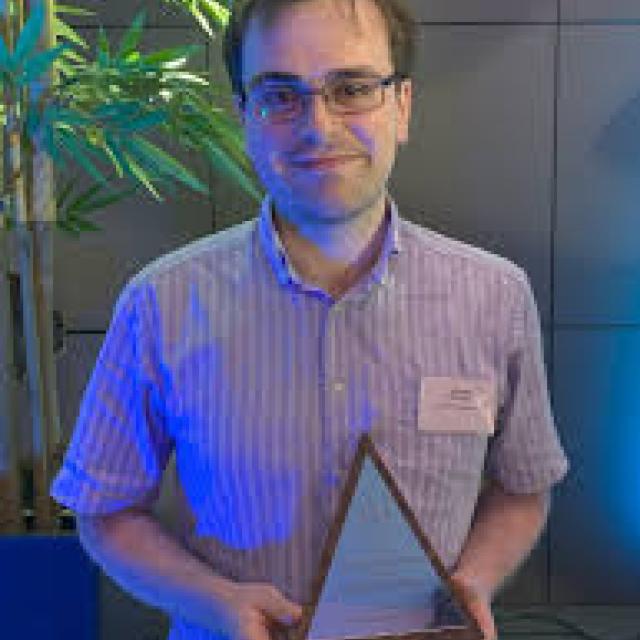
SFU MOCAD Seminar: Matthew Colbrook
Topic
Spectral Surprises at the Boundary
Speakers
Details
Abstract: How does a domain’s geometry shape its spectral properties, and how much of that geometry can we recover from them? First, I will consider Schiffer’s conjecture and show how validated numerics established the existence of a noncircular analytic domain with a nonconstant Neumann eigenfunction that is constant on the boundary (joint work with George Stepaniants). Next, I will turn to Kenig’s conjecture for the Laplace double-layer operator. By introducing boundary features at successively smaller scales, we obtain nonreal essential spectrum and an essential spectral radius greater than 1/2 (joint work with Siavash Sadeghi). I will then show that two analytic, strictly convex planar domains can have the same Neumann–Poincaré spectrum even though no Möbius or anti-Möbius transformation relates them. On the other hand, within a particular two-parameter family near the disc, the first two positive eigenvalues determine the geometry stably (joint work with Habib Ammari). In a short epilogue, I will draw on a few adventures from the past couple of months to discuss how AI is influencing spectral theory and what it takes to verify and understand the results it helps produce.