Maud Menten Institute Summer School: Mathematics of Human-Environmental Systems and Climate Change Impacts
Topic
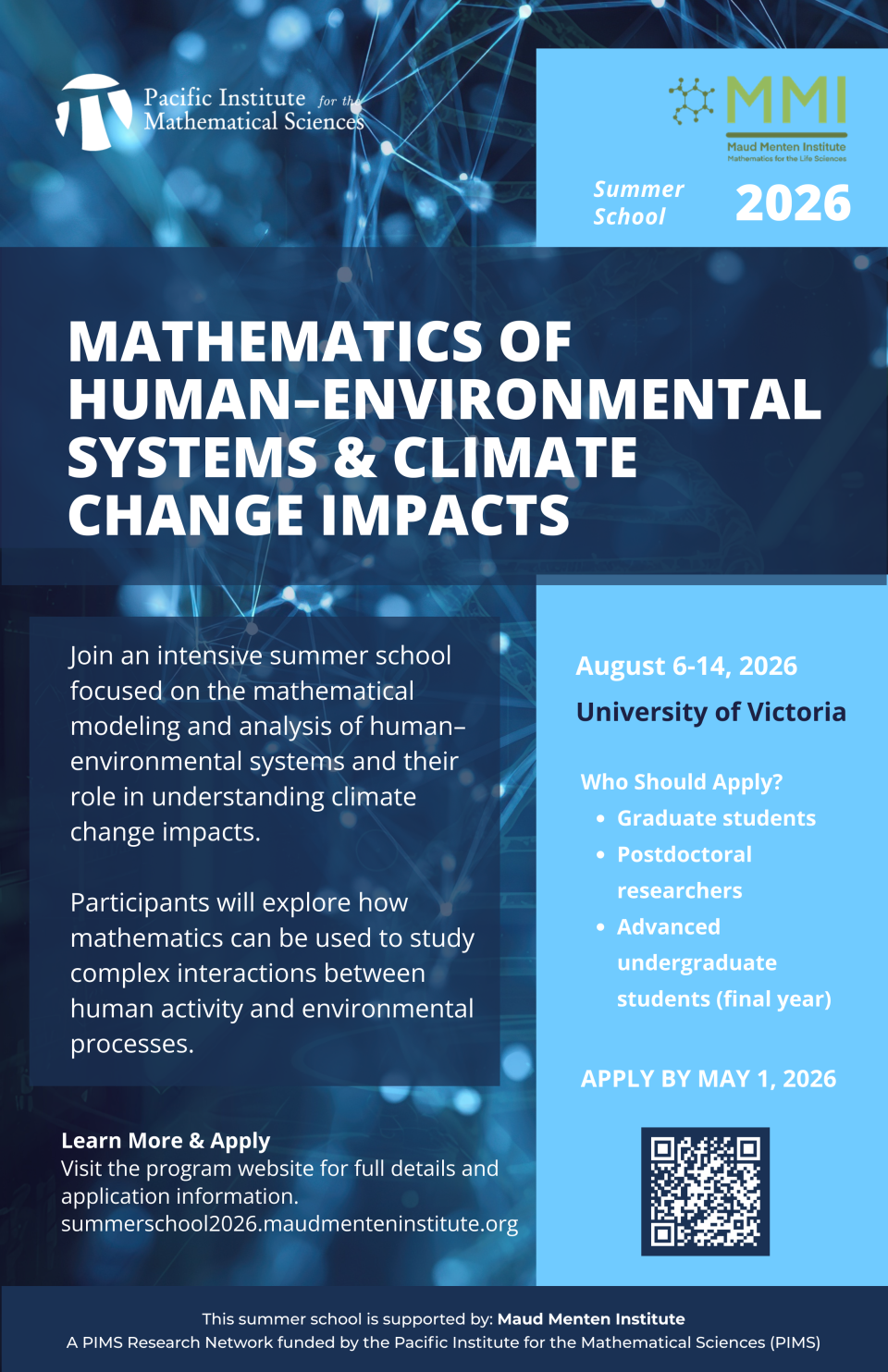
The Maud Menten Institute Summer School on the Mathematics of Human–Environmental Systems and Climate Change Impacts is designed for senior undergraduate students, graduate students, and postdoctoral researchers interested in the mathematical foundations of coupled human–environmental systems.
Participants are expected to have an undergraduate-level background in mathematics (equivalent to at least a minor) and some familiarity with biology. The program consists of four thematic lecture series, four public research talks, and a collaborative short project, providing participants with both theoretical foundations and opportunities for interdisciplinary research engagement.
For more details and the latest updates, please visit the official event website: https://summerschool2026.maudmenteninstitute.org/
Applications now closed - Registrants must be pre-approved prior to registration for the summer school
Speakers



Details
The course content is given below, grouped according to instructor
Jody Reimer (Utah)
Lecture topics: Uncertainty quantification, microbial resistance and optimal decision-making in a changing world
- Microbial community resilience: Microbial communities are the metabolic engines of our planet, yet their stability remains difficult to quantify due to high dimensionality and non-linear interactions. This lecture introduces canonical modeling frameworks and introduces concepts of “resilience” mathematically. We will discuss the unique challenges of contemporary microbial data and explore open questions of both scientific and mathematical interest.
- Natural resource management using Markov Decision Processes: How do we make optimal decisions to manage stochastic and nonstationary ecosystems? This lecture introduces Markov Decision Processes as a formal framework for decision-making under uncertainty. We will derive the Bellman equation and discuss its application to bio-economic problems, including optimal harvesting strategies, conservation resource allocation, and the control of infectious disease outbreaks.
- Uncertainty quantification in a changing world: Uncertainty is unavoidable when modeling human-environmental systems and climate change impacts. This uncertainty can take many forms, including poorly constrained parameters or functional forms, or uncertainty about future climate change scenarios. We will introduce some mathematical tools for quantifying, understanding, and acting in spite of these inevitable uncertainties.
Research talk: Modeling Life on Thin Ice: The Arctic is warming at nearly four times the global average, driving radical ecosystem transformation. While these changes threaten ice-dependent species from microbes to polar bears, they also provide a unique window into the complex feedbacks between biology and climate. This talk explores how mathematical models help us quantify these shifts, highlighting recent successes and the urgent open questions remaining at the heart of polar biology.
Frank Hilker (Osnabrück)
Lecture topics: Dynamics of human-environment systems under anthropogenic change
Humans are a key factor impacting ecological and environmental systems, e.g., through exploitation of natural resources, pollution, habitat deterioration, or greenhouse gas emissions. It is therefore imperative to gain a better understanding how human behavior affects natural systems – and vice versa. Traditionally, many environmental models tend to oversimplify human systems, often in the form of parameters. Similarly, social science research tends to ignore the complexity of ecosystem dynamics. This series of lectures will introduce mathematical modeling approaches that integrate the mutual feedback between human behavior and environmental dynamics.
Research talk: To connect or not connect spatially heterogeneous population patches in fragmented landscapes
Jimmy Garnier (Savoie Mont-Blanc)
Lecture topics: Ecological and genetic consequences of population’s adaptation to environmental changes
How does population adapt to environmental changes? I will present reaction-dispersion models that explore three biological ways to answer this question: ecological adaptation through propagation and long-distance dispersal events; evolutionary adaptation through natural selection; and eco-evolutionary adaptation combining both ecological and evolutionary processes.
Research talk: TBD
Péter K Molnár (Toronto)
Lecture topics: Models to understand ecological and epidemiological impacts of climate change
In these three lectures, I will discuss how physiological models can be combined with population and community dynamics models to understand ecological and epidemiological impacts of climate change. Using a variety of examples, ranging from the management of emerging parasites and diseases to the conservation of polar bears in a changing climate, I will discuss:
- Metabolic Theory of Ecology and Climate Change: How the Metabolic Theory of Ecology can be used to understand direct effects of warming on the survival, reproduction, population dynamics, and geographical range of cold-blooded organisms
- Energy Budget Models and Climate Change: How energy budget models can be used to understand effects of warming on warm-blooded organisms via changes in their resource availability
- Ecological Forecasting for Ecosystem Changes: How to combine these models with ecological forecasting approaches to understand potential futures for ecosystems
Research talk: Thermal Dynamics of Host-Parasite Systems: Modelling and Predicting Disease Emergence and Range Changes in a Warming Climate
Additional Information
There will be an enrollment fee of $250 for successful applicants.
Successful applicants will have food and accommodation provided free of charge, but will be responsible for their own transportation to the summer school.
We look forward to welcoming a diverse group of students eager to enhance their academic journey through our summer school program.
- Event Poster (2.6MB)