University of British Columbia
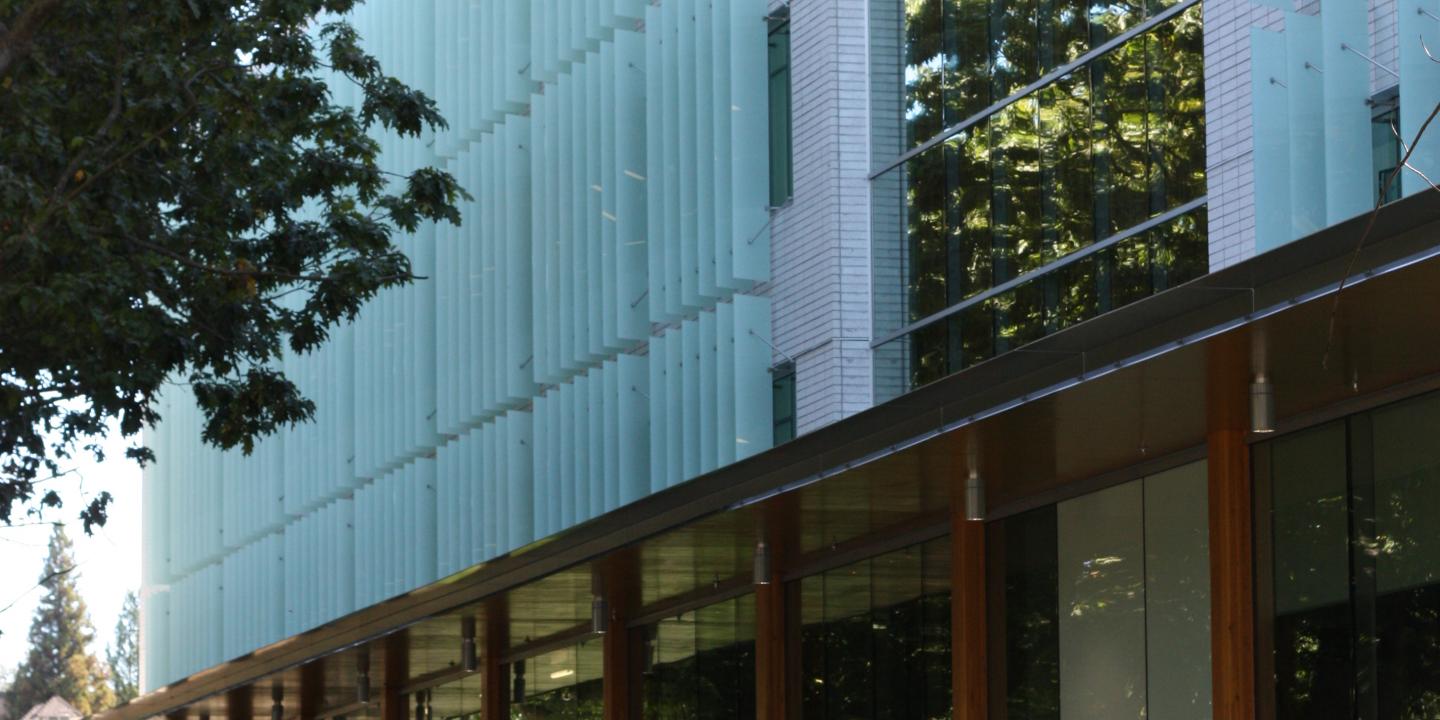
The University of British Columbia PIMS site office is located in the Earth Sciences Building at the University of British Columbia.
Directions
The PIMS offices are located on the 4th floor of the Earth Sciences Building (2207 Main Mall). If using the elevator, our offices will be directly across when you get to the 4th floor. If using the main staircase, the offices will be to your right once you reach the 4th floor.
Airport to PIMS UBC by Bus
From Vancouver Airport (YVR), take the Canada Line Skytrain to Broadway City Hall Station. Get off the platform and walk up to street level. Cross the street and you should see the #99Bline UBC stop outside the Lululemon store. You can take this bus all the way out to UBC. Detailed route information is available through translink's route planner or via google maps. See translink's fare page for up to date prices.
Airport to PIMS UBC by car
To drive from Vancouver Airport (YVR) to UBC, follow signs for Vancouver City Center when leaving the airport. After crossing the Arthur Laing bridge, follow 70th avenue/Marine Drive all the way out to UBC's Point Grey campus. The PIMS offices are in the Earth Science Building on Main Mall which doesn't permit vehicular traffic. The nearest parking lot (or drop off point for Taxis) is on West Mall near the West Parkade at the intersection of West Mall and Bio. Sciences Road (see this map).
Downtown Vancouver to PIMS UBC by car
When leaving Downtown Vancouver, follow signs for UBC (see this map).
Tsawwassen Ferry Terminal to PIMS UBC by car
Follow directions for Vancouver airport until you reach the City of Vancouver, then follow the directions above for travelling from the airport.
US Border to PIMS UBC by car
Follow directions for Vancouver until you reach the City of Vancouver, then follow the directions above for travelling to PIMS from the airport. Please make sure you have the correct travel documents and follow instructions
Travelling between UBC and SFU by bus
There are many public transit options for travel between UBC and SFU but please note the universities are at opposite ends of Vancouver (SFU is actually in Burnaby) and travel can take an hour or more. Visit Translink for more travel options.
Staff
| Position | Name | Phone # | Office | |
|---|---|---|---|---|
| PIMS Site Director & Professor of Mathematics, University of British Columbia | Brian Marcus | marcus@math.ubc.ca | +1 (604) 328-1471 | Math Building 218 |
| PIMS Co-Director, Programs; Professor of Mathematics, University of British Columbia | Deanna Needell | co-director-programs@pims.math.ca | 4156 | |
| Chief Operations Officer | Denise Feighan | denise@pims.math.ca | (604) 822-1522 | Room 4158 |
| Professor, Department of Mathematics, University of Washington | Gabriel Paternain | international@pims.math.ca | ||
| Technology Manager | Ian Allison | iana@pims.math.ca | (778) 991-1522 | Room 4126 |
| Program and Events Manager | Joanne Jiang | programs@pims.math.ca | (604) 822-3611 | Room 4168 |
| PIMS Communications Manager | Kate Flett | communications@pims.math.ca | 604 822 0406 | Room 4162 |
| Communications and Event Assistant | Lisa Sammoh | lisa@pims.math.ca | (604)822-3922 | ESB4166 |
| PIMS Education Coordinator, University of British Columbia | Melania Alvarez | melania@pims.math.ca | (604) 822-0404 | Room 4164 |
| Executive Assistant | Oscar Cetnarowski | executive-assistant@pims.math.ca | (604) 822-3922 | ESB4173 |
| PIMS Director, Professor of Mathematics University of British Columbia | Özgür Yilmaz | director@pims.math.ca | (604) 822-0406 | Room 4162 |
| Finance Manager | Pooja Sharma | finance@pims.math.ca | (604) 822-3782 | Room 4172 |
| Name | Original Location | In | Out |
|---|---|---|---|
| Seick Kim | Yonsei University | ||
| Perla Kfoury | University of Toulouse | ||
| Stefan Le Coz | University of Toulouse | ||
| Hui Chen | Zhejiang University of Science | ||
| Takahisa Inui | Osaka University | ||
| Rustum Choksi | McGill University |
| Name | Position | Research Interests | Supervisor | Year |
|---|---|---|---|---|
| Joshua P Turner | PIMS Postdoctoral Fellow, University of British Columbia | Algebraic Geometry, Topology, and Combinatorics | Sabin Cautis | 2025 |
| Federico Trinca | PIMS-Simons Postdoctoral Fellow, University of British Columbia | Differential geometry & PDE | Sebastien Picard | 2024 |
| Jakwang Kim | PIMS Postdoctoral Fellow, University of British Columbia | Statistics | Young-Heon Kim | 2023 |
| Lucas Teyssier | PIMS-Simons Postdoctoral Fellow, University of British Columbia | Probability Theory & Stochastic Processes | Jonathan Hermon | 2023 |
| Paul Péringuey | PIMS Postdoctoral Fellow, University of British Columbia | Number Theory | Greg Martin | 2023 |
| Sarah Dijols | PIMS Postdoctoral Fellow, University of British Columbia | Representation Theory | Julia Gordon | 2023 |
| Gai Guodong | PIMS Postdoctoral Fellow, University of British Columbia | Fluid Mechanics | Anthony Wachs | 2022 |
| Nabarun Deb | PIMS Postdoctoral Fellow, University of British Columbia | Optimal Transportation | Young-Heon Kim | 2022 |
| Nicholas Rouse | PIMS Postdoctoral Researcher, University of British Columbia | Low Dimension Topology | Ben Williams | 2022 |
| Timon Salar Gutleb | PIMS Postdoctoral Researcher, University of British Columbia | Numerical Analysis | Christoph Ortner | 2022 |
| Anirudh Asuri Mukundan | Postdoctoral Researcher | Fluid Mechanics | Anthony Wachs | 2021 |
| Evan Miller | Postdoctoral Researcher | Partial Differential Equations | Tai-Peng Tsai | 2021 |
| Wenzhao Chen | Postdoctoral Researcher | Manifolds and Cell Complexes | Liam Watson | 2021 |
| Babru Joshi | University of British Columbia | High Dimensional Data Analysis | Özgür Yilmaz | 2019 |
| Brian Freidin | Postdoctoral Researcher, University of British Columbia | Differential geometry | Jingyi Chen | 2019 |
| Hugo Lavenant | University of British Columbia | Partial Differential Equations | Young-Heon Kim | 2019 |
| Thomas Budzinski | University of British Columbia | Probability | 2019 | |
| Arthur Ghigo | University of British Columbia | Fluid Mechanics | Anthony Wachs | 2018 |
| Jishnu Ray | University of British Columbia | Number Theory | Sujatha Ramdorai | 2018 |
| Jongchon Kim | University of British Columbia | Fourier Analysis | Malabika Pramanik | 2018 |
| Yifan Sun | University of British Columbia | Computer Science | Michael Friedlander | 2018 |
| Fei Hu | University of British Columbia | Geometric Topology | Zinovy Reichstein | 2017 |
| Nguyen Lam | University of British Columbia | Partial Differential Equations | Nassif Ghoussoub | 2016 |
| Nicolau Sarquis Aiex | Geometric Analysis | Jingyi Chen | 2016 | |
| Tobias Huxol | University of British Columbia | Geometric Analysis | Ailana Fraser | 2016 |
| Abbas Mehrabian | University of British Columbia | Optimization | Nick Harvey | 2015 |
| Justin Tzou | University of British Columbia | Applied Partial Differential Equations | Michael Ward | 2015 |
| Richárd Balka | University of British Columbia | Probability | Ed Perkins | 2015 |
| Duncan R. Hewitt | University of British Columbia | Fluid Mechanics | Neil Balmforth | 2014 |
| Khoa Dang Nguyen | University of Calgary | Diophantine geometry and algebraic dynamics | Dragos Ghioca | 2014 |
| Nicolo Sibilla | PIMS Postdoctoral Fellow | Geometry and Physics | Jim Bryan | 2014 |
| Sedi Bartz | PIMS Postdoctoral Fellow | Optimization | Heinz Bauschke | 2014 |